
Free Access vs Paid Tiers: What Changes
The honest way to compare access levels is to measure your own habit first and read the plan page second. Ten messages a day across 30 days is 300 messages a month; forty a day is 1,200; a hundred and twenty a day is 3,600. Whichever figure matches how you actually use adult chat is the figure you need to test against, because volume is where access levels show up in daily use.

Key takeaways
- Count first: 10, 40 or 120 messages a day is 300, 1,200 or 3,600 a month, and that range covers most habits.
- The platform introduces itself as Porn Chat AI and lists customisable characters, privacy and realistic responses as its core properties rather than as level-specific extras.
- Compare continuity, not catalogue: what matters is whether a saved character, its memory and your preferences carry forward as you change level.
- No price or tier figure appears here because none was published in the source material; the Crushon plan page is the only place to read the current terms.
Measure the habit before reading the offer
Most access-level confusion comes from comparing features that a reader has never used. A better starting point is a one-week log. Note how many days you opened the site, how long each session ran, and roughly how many messages you sent. At the end of the week multiply: seven days of 40 messages is 280 messages, which is close to the 1,200 a month that 40 a day would produce over 30 days.
That number does two things. It tells you whether you are a light, moderate or heavy user in your own terms, and it gives you a specific question to answer on the plan page rather than a vague sense that more would be nice. Readers who skip this step tend to pay for headroom they never use or to hit a ceiling on a busy weekend and blame the wrong thing.
A second measurement is more subtle: count how many characters you saved in that week. Saved entries are the part of the experience that compounds, so a week that produces five saves is doing more work for you than a week of heavy chatting with nothing kept.
What actually differs between access levels
Three dimensions matter in practice. Volume is the first: how much conversation a level supports. Continuity is the second: whether memory and saved entries behave the same way as you move between levels. Support and account surfaces are the third, since the site publishes reporting and compliance routes that any adult user may need.
Everything else tends to be cosmetic. The catalogue itself is presented the same way — the trends board, the search filters and the weekly rankings are the same pages regardless of level, and the character cards carry the same two counters. Where the levels diverge is in how much you can do with what you find.
| Dimension | What to test | Why it matters |
|---|---|---|
| Message volume | Your logged week against the level's stated allowance | 300, 1,200 and 3,600 messages a month are very different habits |
| Session length | Whether a long single session is comfortable or gets interrupted | A 60-minute session costs four times the time of a 15-minute one |
| Saved library | Whether saves, labels and notes stay put as the level changes | The library is the only asset that compounds over months |
| Memory behaviour | Whether a character still recalls earlier context on your level | Continuity is what makes a resumed scene cheap |
| Account surfaces | Reporting, compliance and support routes remain available | Every adult user may need the content removal process at some point |
Worked example: three habits, one decision
Take three illustrative readers. The first sends 10 messages a day, which is 300 in a 30-day month, and runs four sessions a week of about a quarter of an hour; that habit is 16 sessions a month, which is 4.0 hours. The second sends 40 a day, or 1,200 a month, in 16 sessions of half an hour, which is 8.0 hours. The third sends 120 a day, or 3,600 a month, in 16 sessions of an hour, which is 16.0 hours.
Check the arithmetic on the third: 16 sessions times 60 minutes is 960 minutes, and 960 divided by 60 is 16.0 hours. The same 16 sessions at 30 minutes gives 480 minutes, or 8.0 hours, and at 15 minutes gives 240 minutes, or 4.0 hours. Those session lengths and message counts are worked examples of three habits, not platform measurements, but they are enough to place almost any real user in one of the three columns.
The decision follows from the placement. The light habit rarely needs more than the entry level offers. The moderate habit needs to check continuity rather than volume, because its sessions are long enough for memory to matter. The heavy habit is the one where a stated allowance is the deciding line, and the only place to read that line is the site's own plan page.
What does not change, and why that is reassuring
The pages that govern behaviour stay the same. Content provenance is covered by the platform's 2257 statement, which says the material is AI-generated text and depicts no real person. Reporting runs through each content page and through [email protected], described on the content removal policy. And the service's own FAQ notes that some limitations apply under its content and community guidelines, whatever level a reader is on.
That consistency is the useful part of the comparison. Paying changes how much you can do; it does not change what the platform is, what the material consists of, or how reports are handled. Anyone weighing the porn ai chat service should be able to read the same description and the same rules at every level, and judge the difference as one of capacity rather than of character.
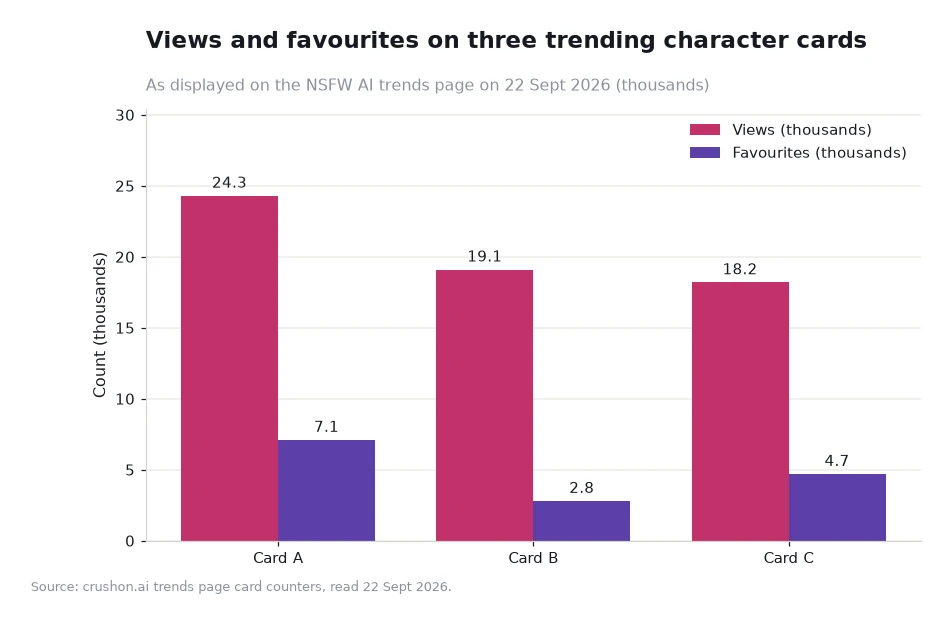
There is also a symmetry worth noting. The published card counters show the same asymmetry whether you are signed in at one level or another: careful saves are far rarer than casual views, with 7.1K favourites against 24.3M views on the top card and 4.7K against 18.2M on another. The board does not adjust itself to your account, which means a saved library remains the most personal signal you have.
Frequently asked questions
Is a paid level faster or different in kind?
Treat that as a question to answer from the plan page rather than from expectation. The published material describes one service; the levels describe capacity and terms.
What happens to saved characters if I change level?
Ask the support address if the answer is not stated, and test it on a small scale by saving a few entries and checking they persist after any change.
Should a light user ever upgrade?
Usually not on volume grounds. Light habits are driven by available time rather than by an allowance, so the constraint is the calendar, not the level.
Log a week, then decide
Spend one week logging sessions and messages, add the totals up, and compare them with what each access level says. Then decide in one direction or the other and stop revisiting the question every month, because the deciding variable is your own habit and that changes slowly.
Write the totals down somewhere you will see them again in six months. If the log then shows a habit that has moved a great deal, it is worth re-reading the plan page; if it has barely moved, the question is already settled and the time is better spent curating your library of characters.
Data and sources: service description and FAQ on the platform's adult chat page[1], with plan wording taken from the plan page itself[2]. Trend counters read, and worked examples calculated, on 22 Sept 2026; no prices appear because none were published in the source material. Prepared for adults aged 18 and above; read 22 Sept 2026.