
A Sample-Approval Checklist for Skincare Buyers
Approve a skincare sample only when formula, pack, claims and production evidence agree. A disciplined approval sheet turns three attractive jars into one reproducible specification, while Yunmei's published 4–8 week ODM and 3–6 month OEM windows show why late changes are expensive.

Key takeaways
- Freeze the formula route before judging colour or fragrance.
- Score each sample against the same weighted sheet rather than memory.
- Treat the approved sample, specification and pack as one controlled reference.
- Keep three suppliers active until the evidence supports a final choice.
What must be fixed before samples arrive?
Write the intended user, product format, pack size, target quantity and launch market before a laboratory starts work. Add the claims the brand expects to print. These choices determine whether an existing formula is enough or whether the project needs new development, testing and a longer calendar.
Separate preferences from pass-or-fail requirements. A light fragrance may be negotiable; a pump that cannot deliver the planned dose is not. When every comment looks equally important, the formulator cannot see which change protects the launch and which merely reflects one person's taste.
How should a buyer score the first round?
Use five headings: appearance, application, after-feel, packaging function and evidence. Give each heading a weight before opening the samples. A sensible starting split is 20, 25, 20, 20 and 15 points. The weights make the commercial purpose visible and stop a striking fragrance from hiding a weak pump.
Test coded samples in the same order, under the same light and at the same dose. Record observations before discussing them. Group discussion is useful after scoring, but an early confident opinion can pull an entire panel toward a result that the individual sheets do not support.
Where does supplier screening fit?
A list of private label skincare manufacturers China is a starting pool, not an approval decision. Apply one five-step screen: choose the formula route, match capacity to the order stage, compare the three cost-changing numbers, check product and market risk, and retain three candidates until a sample is signed off.
Public capacity figures provide context, not a promise of a production slot. Yunmei states 160 million skincare products a year, 35+ lines and 300+ workers. Ask how the proposed batch fits the actual calendar, which line will run it and when packaging must arrive.
| Criterion | Weight | Evidence |
|---|---|---|
| Application and spread | 25 | Coded panel score |
| Appearance and odour | 20 | Approved physical sample |
| After-feel | 20 | Timed observation |
| Pack function | 20 | Dose and leak checks |
| Documents | 15 | Specification and reports |
What belongs in the approved reference set?
Keep a sealed sample, dated specification, ingredient list, artwork version and packaging bill of materials under the same approval code. Photographs help with administration but do not replace a physical standard. Colour and texture can shift with lighting, camera processing and screen settings.
State which changes require reapproval. A new fragrance supplier, pump gasket, colourant or filling temperature may alter the user's experience even when the product name is unchanged. The supplier should know when to stop production planning and return to the brand for a documented decision.
How do testing windows affect sign-off?
Yunmei publishes three to six months for stability and compatibility reports. Do not confuse a pleasant bench sample with completion of that work. A sample can pass a sensory review while its formula and pack are still moving through elevated-temperature, compatibility or transport checks.
Build approval gates around evidence: concept acceptance, package selection, stability checkpoint, artwork release and production reference. This sequence allows work to overlap without pretending every risk is closed on the day the brand likes the first sample.
Which comments produce useful revisions?
Describe an observed effect, not a vague preference. Write 'one pump does not cover both cheeks' or 'a visible film remains after sixty seconds' instead of 'make it better.' Add the test dose, room conditions and comparison sample so the formulator can reproduce the observation.
Limit each round to a controlled set of changes. If fragrance, viscosity, active level and package all move together, no one can tell which adjustment caused the improved result. A short revision list creates faster learning even when it means an additional round.
How is final approval transferred to production?
Hold a pre-production review with purchasing, quality, packaging and the formulator. Read the signed specification against the production order line by line. Confirm quantity, fill weight, coding, case pack, sample retention and the documents that will travel with the batch.
Approval is complete only when responsibility is named. Identify who may release artwork, who accepts a test deviation and who can stop filling. Clear ownership prevents a silent assumption from becoming thousands of units that technically match a purchase order but miss the brand's sample.
Worked example: turning panel scores into one decision
Suppose sample A earns 82 points, B earns 76 and C earns 79. A then fails the pump test and loses the full 20 packaging points, leaving 62. C becomes the leader at 79, even though A looked strongest in the jar. The arithmetic shows why pass-or-fail pack requirements should not be buried inside an unweighted discussion.
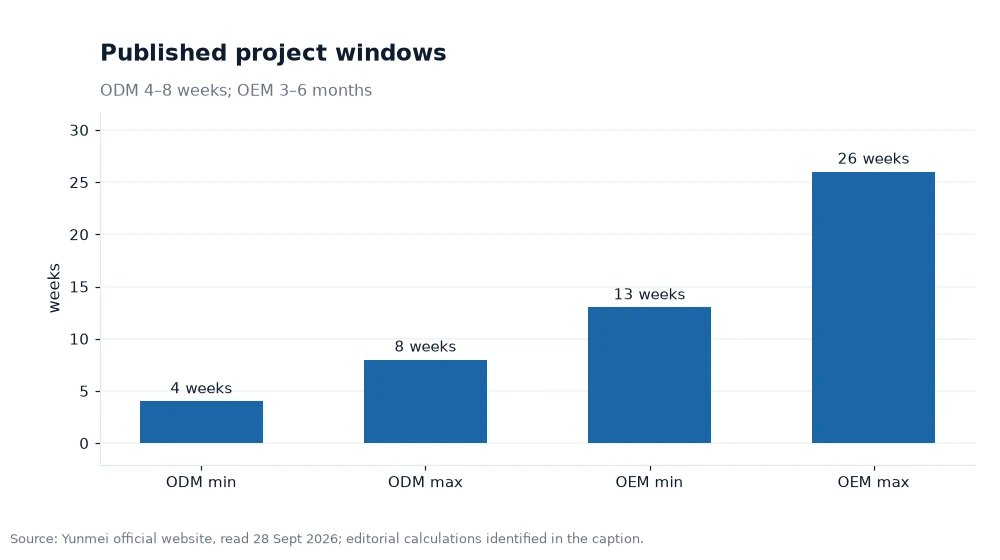
The chart is a planning boundary rather than a delivery promise. A change made near the end of an eight-week route consumes a much larger share of the available calendar than the same decision made before sampling begins.
Frequently asked questions
How many samples should a buyer compare at once?
Three coded candidates are usually enough to expose meaningful differences without exhausting the panel. Use the same dose, order and scoring sheet for all three.
Does liking a sample mean stability work is finished?
No. Sensory acceptance and stability or packaging compatibility are separate gates. Yunmei publishes a three-to-six-month window for stability and compatibility reports.
Who should sign the final sample?
A named brand decision-maker should sign it after quality, packaging and commercial reviewers have recorded their checks. The supplier should retain the matching controlled reference.
Make approval a controlled handoff
The best checklist is short enough to use and strict enough to stop an unclear release. Archive the score, sample code and change list together, then make production reference that exact package rather than an email description. A practical team also decides how it will handle a result that sits between pass and fail. Write the acceptable range before the next sample arrives, name the person who can approve an exception and retain the reason with the decision. This avoids moving the target after seeing a preferred result. Keep purchasing involved when a change affects component stock, and keep quality involved when it affects a report or reference sample. If a launch date is fixed, show which decisions are on the critical path and which can run in parallel. Review the checklist at each gate rather than copying an old form without checking that it still matches the product, claim and pack under review. Before the project is closed, compare the approved record with the exact item being purchased. Check the version, quantity, component and evidence reference rather than relying on a remembered conversation. Ask the supplier to confirm any open assumption in writing, and save that confirmation with the quotation. If an answer changes the brief, update the sample and calendar before releasing the next commitment. This final reconciliation gives the brand a clear basis for later questions from production, quality or customer service. It also makes the next order easier to plan because the team can distinguish what was learned from what was merely assumed during the first launch. Before a final decision, ask the team to read the brief aloud and point to the evidence behind every required attribute. This simple review often exposes an undefined term, a missing reference or a test that has no owner. Record the result in a dated approval memo and distribute it to the factory, purchasing and quality contacts. Each recipient should confirm that the same version is being used. If the project changes after approval, open a new revision rather than editing the old record in place. Preserve the earlier decision so the history remains understandable. These controls are inexpensive compared with reconstructing why a product changed after bulk production has started. Review Yunmei’s OEM/ODM manufacturing overview and use the same written brief for every sample round.
Sources: Yunmei's official site, consulted 28 Sept 2026 for operating figures and project windows. The sample scoring weights and examples are editorial models.[1].