
One Machine at Home: How Many Days Until You Hold 0.01 BTC?
A single ASIC in a spare room earns in thin daily slices, so the calendar matters more than the sales brochure. At 50 TH/s the arithmetic gives 0.00002243 BTC a day, which stretches 0.01 BTC across 445.8 days at current difficulty. A 500 TH/s setup shortens the same goal to 44.6 days, with the network at 1,003 EH/s and 450 BTC issued daily.
Key takeaways
- 50 TH/s credits about 0.00002243 BTC a day, so 0.01 BTC takes 445.8 days.
- 500 TH/s earns ten times faster, cutting the same target to 44.6 days.
- All figures rest on 21 Sept 2026 inputs: 1,003 EH/s network, 450 BTC a day, BTC at $84,692.
- Pool Hashrate and Pool Luck describe live conditions, while PPS+ still settles the block-reward slice hourly against difficulty.
What one machine actually earns per day
Start with the share. Your rig contributes its terahash to a network carrying roughly 1,003 EH/s, and the protocol issues 450 BTC a day across 144 blocks at the current 3.125 BTC subsidy. Divide one by the other and each TH/s is worth close to 0.00000044865 BTC daily. Multiply by your machine and the day takes shape: a 50 TH/s box lands near 0.00002243 BTC, worth about $1.90 at $84,692 per coin.
That daily slice looks small because it is small, and naming it early prevents disappointment later. A home rig is a slow tap rather than a bucket. The listed 4% on the PPS-settled block-reward component trims the gross by a thin margin, and the transaction-fee component carries its own listed 2% under PPLNS-style sharing. Once those slices are understood, the day rate becomes a planning input instead of a surprise.
From 445 days to 44: reading the four timelines
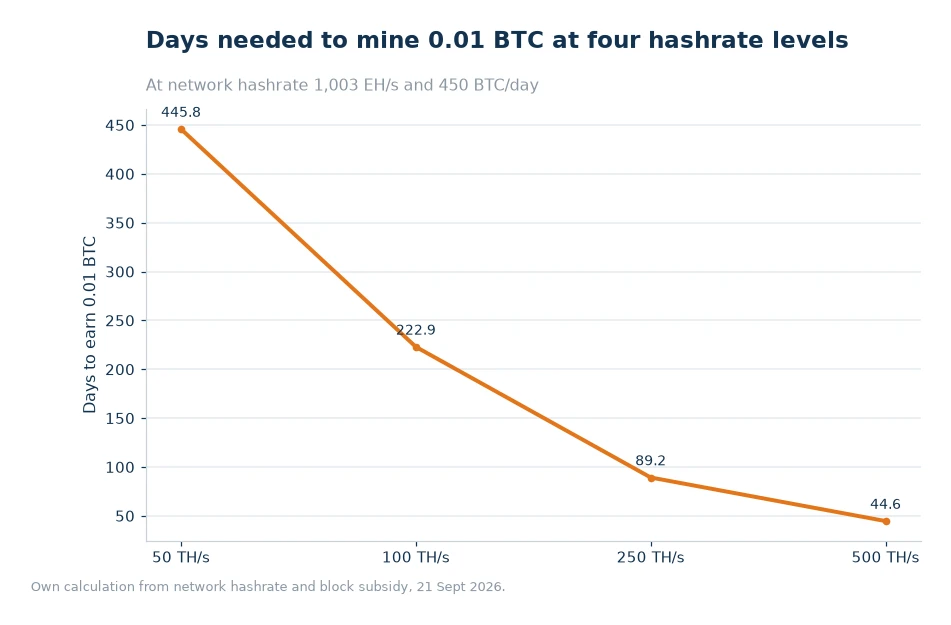
The chart below answers one question at four rig sizes: how long until 0.01 BTC? At 50 TH/s the answer is 445.8 days, past a full year. Step up to 100 TH/s and the wait halves to 222.9 days. A 250 TH/s machine needs 89.2 days, and a 500 TH/s unit finishes in 44.6 days. The relationship is a straight inverse because difficulty and issuance are held fixed in the calculation.
Read the curve as a shopping guide. If a seller promises that a 50 TH/s box will stack 0.01 BTC in a few months, the arithmetic disagrees, and arithmetic does not negotiate. If your goal is a fixed date rather than a fixed coin amount, pick the hashrate whose timeline lands inside it, then check whether your power price and noise tolerance survive the same choice.
Why the pool dashboard beats watching blocks
Solo mining at 50 TH/s means waiting on an event with a 190-year average at 100 TH/s, let alone half that. Pool mining replaces the lottery ticket with metered shares: every submitted share counts toward an hourly credit, and the credit lands whether or not the pool found the block that hour. That steadiness is the whole reason a home miner joins a pool rather than pointing at the network alone.
The ViaBTC BTC Mining Pool status view shows the live side of that bargain, including Pool Hashrate across supported coins and the Pool Luck readout for recent blocks. Under PPS+ the block-reward slice ignores short-term luck and pays against current difficulty, so a red week on the luck chart does not shrink your hourly credit. PPLNS behaves differently and shares both reward and fees at a listed 2%, which suits miners comfortable with variance.
Heat, noise and power: the home costs that count
Coins arrive slowly; heat arrives immediately. A single ASIC turns most of its wall power into warm air, so the room needs an exit path for it: a cracked window in winter, ducting to an exhaust in summer, and a plan for the weeks when both fail. Measure the intake and exhaust temperatures for a weekend before committing to a permanent spot, because a machine that thermal-throttles earns below its nameplate hashrate.
Noise is the second landlord. One modern miner at full fan sounds like a vacuum that never finishes, which rules out bedrooms and shared walls. A closet with ventilation, a garage corner, or a sound-dampened box each cut decibels at some cost in airflow, so budget for the enclosure the same way you budget for the machine. Power is the third line: log the meter for a week, multiply by your tariff, and hold that weekly cost against the $1.90 a day a 50 TH/s rig grosses.
A weekly habit that keeps a small rig honest
Small operations drift because nobody watches them. A ten-minute Sunday check fixes that: record the pool-reported hashrate, the credited BTC for the week, and any rejected-share rate above 1%. If reported hashrate trails the nameplate by more than a few percent for two weeks running, clean the filters, check the firmware, and look for a hot board before assuming the pool is at fault.
The Profit Calculator earns its place in that routine. Punch in current difficulty near 132.76 T, your effective hashrate, and the listed fee, and it restates the daily expectation in dollars. When the calculator says $1.90 a day and your week shows $12.60 after seven days, the half-dollar gap is the fee slice plus variance, not a malfunction. That comparison keeps support tickets for genuine faults.
| Rig size | BTC per day | USD per day | Days to 0.01 BTC |
|---|---|---|---|
| 50 TH/s | 0.00002243 | $1.90 | 445.8 |
| 100 TH/s | 0.00004487 | $3.80 | 222.9 |
| 250 TH/s | 0.00011215 | $9.50 | 89.2 |
| 500 TH/s | 0.00022430 | $19.00 | 44.6 |
The table carries the same message as the chart in plainer units: doubling the rig halves the wait. A renter splitting power with roommates will read the 50 TH/s row and think in years, while someone with a garage and cheap power will price the jump to 250 TH/s against months saved. Either way the network does not care where the machine sits; only the hashrate and the difficulty enter the division.
Worked example
Follow the 50 TH/s row from raw network inputs to the 445.8-day answer, then scale it to the largest rig.
- Daily BTC per TH/s: 450 ÷ 1,003,000,000 = 0.00000044865.
- At 50 TH/s: 50 × 0.00000044865 = 0.00002243 BTC a day.
- Days to 0.01 BTC: 0.01 ÷ 0.00002243 = 445.8 days.
- Dollar check: 0.00002243 × 84,692 = $1.90 a day.
- At 100 TH/s the day rate doubles to 0.00004487 BTC, so 0.01 ÷ 0.00004487 = 222.9 days.
- At 250 TH/s: 250 × 0.00000044865 = 0.00011215 BTC a day, and 0.01 ÷ 0.00011215 = 89.2 days.
- At 500 TH/s: 500 × 0.00000044865 = 0.00022430 BTC a day, and 0.01 ÷ 0.00022430 = 44.6 days.
- The listed 4% applies to the PPS-settled block-reward component of those figures, shaving gross by a small fraction rather than rewriting the calendar.
Frequently asked questions
Can a single home machine still earn anything measurable?
Yes, in metered drips. A 50 TH/s box credits near 0.00002243 BTC a day, about $1.90 at $84,692, and pool shares mean the credit arrives hourly under PPS+ instead of waiting on a solo block.
Do pool fees change the 445-day timeline much?
Only at the margin. The listed 4% touches the PPS-settled block-reward component and the listed 2% touches the fee component, so the calendar stretches by a small fraction rather than doubling.
Where do I check that the estimate still holds?
Watch the pool dashboard for Pool Hashrate and Pool Luck, and re-run the calculator when difficulty moves. A difficulty shift near the −2.12% estimate moves daily output by a similar percentage.
Set a date on the calendar, then decide
Pick the milestone first and let the table choose the machine. If 0.01 BTC within a season matters, the 500 TH/s row at 44.6 days is the honest minimum; if the goal is learning the ropes, the 50 TH/s row teaches the same lessons over 445.8 days at lower cost. Either choice deserves a power log, a noise plan, and a weekly glance at credited versus expected coins.
Before ordering hardware, confirm the fee treatment on the fee schedule so the listed 4% and 2% enter your spreadsheet on the correct components. Then run the four timelines once more with your tariff filled in. The rig that survives that second pass is the one to buy.
Sources: the ViaBTC fee and pool status pages for the listed rates and live Pool Hashrate and Pool Luck readouts, and support guides for setup steps[1]. Chain data read 21 Sept 2026: network hashrate 1,003 EH/s, difficulty 132.76 T, 3.125 BTC per block, 144 blocks a day, BTC $84,692. Figures published 11 Nov 2026; credit math assumes continuous uptime at nameplate hashrate.