
What Has Changed in Sample-to-Bulk Scaling for Middle East Launches
The physical work of scaling an approved fragrance into a bulk order has barely changed in a decade: materials are weighed, the batch is mixed, macerated, filled and sealed. What has changed is everything around that work. Restriction lists are revised more often, documentation arrives earlier in the project, heat testing has become a purchasing question in Gulf markets, and approvals increasingly happen on screens instead of at a bench. Teams still planning a 2015-style sample-to-bulk handover tend to lose weeks to paperwork rather than to chemistry.
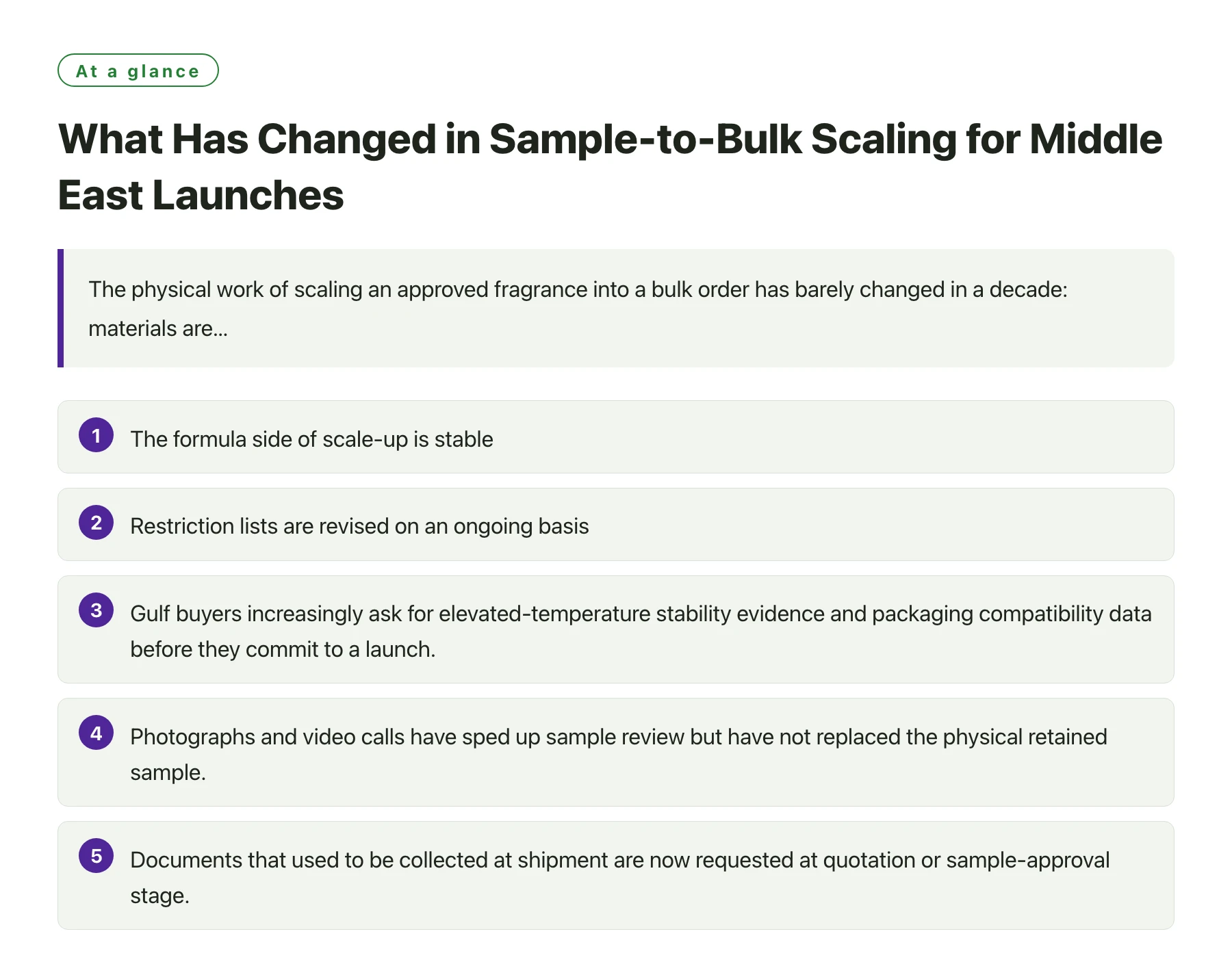
Key takeaways
- The formula side of scale-up is stable; the compliance and documentation side is what keeps moving.
- Restriction lists are revised on an ongoing basis, so a formula that passed two years ago may have less headroom today.
- Gulf buyers increasingly ask for elevated-temperature stability evidence and packaging compatibility data before they commit to a launch.
- Photographs and video calls have sped up sample review but have not replaced the physical retained sample.
- Documents that used to be collected at shipment are now requested at quotation or sample-approval stage.
- A supplier's institutional memory matters more now, because the changes are cumulative rather than one-off.
Ask a product team what changed in fragrance manufacturing and the honest answer is usually nothing dramatic. Ask what changed in getting a Gulf launch approved, shipped and listed, and the answer is a list: more paperwork, more evidence, earlier deadlines, and less tolerance for a specification that exists only in emails.
This is not bureaucracy for its own sake. Each new request traces back to a real commercial pressure — a retailer protecting itself, an importer managing risk, a brand trying to avoid a reformulation after packaging is printed. Understanding the reason makes the requests easier to plan for rather than resent.
The five shifts below are the ones that most often surprise brands returning to manufacturing after a few years away, or teams moving from a European launch to a Gulf one.
Restriction lists move, so headroom is now a live variable
Fragrance materials are governed by use standards that are periodically revised. A formula approved three years ago may still be compliant today and yet have much less room left before a limit than it did at approval. That matters at scale-up, when quantities change and when a brand may want to raise the oil load for a different market.
The practical consequence is that headroom checks have moved from a one-off at formula approval to a recurring question at each bulk order. The reference points are public: the standards library maintained by the International Fragrance Association sets out which materials are restricted and in which product categories [1].
Why this hits Gulf briefs harder
Regional briefs often call for richer, heavier directions, which usually means a higher oil load and larger doses of the heavier materials. Both consume more of the available allowance. A formula with thin headroom can therefore become a scale-up problem precisely because the market brief was met successfully.
What to ask, and when
Ask which materials in the approved formula carry restrictions and how much room each has left, and ask again before each bulk order. The answer belongs in the specification next to the concentration, not in a separate email thread that only one person can find.
Documentation arrives earlier in the project
A decade ago, a buyer could reasonably expect to collect conformity documents close to shipment. Today those requests tend to arrive at quotation or sample approval, because importers and retailers price their own risk earlier in the process. Trade coverage of the fragrance and personal care sector has tracked this shift for years: compliance questions have moved from the shipping desk to the buying desk [2].
For a sample-to-bulk project the effect is concrete. The document list is now part of the brief, and a supplier that cannot produce a document until after filling becomes a schedule risk rather than a paperwork inconvenience.
What buyers ask for sooner
Quality system evidence, batch documentation practice, safety paperwork for the finished product, and labelling confirmation tend to be requested before the purchase order rather than after it. None of those requests is unreasonable, but each one needs a named owner on both sides.
Why the retained sample became an audit item
As documentation moved earlier, so did the expectation that the approved sample is a controlled record rather than a keepsake. Buyers now ask who holds the reference sample, how it is stored and how a delivered batch is compared against it. That question is much easier to answer when the specification names the sample.
Heat evidence turned into a purchasing question
Gulf markets were always hot; what changed is that buyers now ask for evidence rather than reassurance. A quotation that says the product is stable is no longer enough when goods will sit in high temperatures during transit and storage.
The request usually takes two forms: stability work at elevated temperature, and packaging compatibility, meaning the bottle, closure, pump and decoration tested together as a finished pack rather than as separate parts. Market research on the region continues to describe beauty and fragrance as an area of growth, which raises the stakes for a launch that arrives damaged or off-profile [3].
Why the pack, not just the juice
Heat problems often appear in the packaging first: adhesive lifting, coating dulling, print shifting, or a pump that behaves differently after storage. Testing the formula alone answers a question nobody asked.
What a buyer should request
Ask what was tested, at what temperature, for how long, and which components were assembled for the test. If the answer is a general claim with no test conditions attached, treat it as a conversation starter rather than as evidence.
Approvals moved onto screens, but the handover did not
Sample review is faster than it used to be. Photographs, video walkthroughs of a filling line and courier tracking have compressed the feedback loop, and that is a genuine improvement for teams working across time zones.
The risk is subtle: an approval given from a screen is not the same as an approval given from a bottle. Colour, weight, spray quality and the opening of a scent all behave differently in person. Teams that approve on video and skip the physical check tend to discover the gap when the bulk order is already packed.
A workable compromise
Use remote review to eliminate obviously wrong options, then require a physical reference before the bulk order is confirmed. That keeps the speed advantage without turning the reference sample into a formality.
Where remote approval fails hardest
Decoration and packaging are the weakest candidates for screen approval, because coatings, frosting and metallic effects change with lighting. Fragrance evaluation is a close second, since a scent described over a call is a translation of a translation.
What is worth asking now that was unusual a decade ago
The cumulative effect of these shifts is a longer question list at the start of a project, and a shorter list of surprises at the end. Five questions cover most of it: how much restricted-material headroom is left; which documents can be issued before filling; what heat testing covers and under what conditions; who holds the retained reference sample; and which party owns the formula, artwork and tooling if the project stops.
That last question is where experienced suppliers separate themselves, because the answer depends on institutional practice rather than on policy wording. A manufacturer that has been running export projects for decades has usually seen each of these issues before and can describe how it handles them without improvising. It is reasonable to weigh that accumulated experience as a real part of what a supplier offers — a company like Xuelei Perfumes states Xuelei's 31 years in fragrance as part of how it presents its manufacturing background, and the useful test is whether the practices behind the number are visible in the answers to the five questions above.
Sources
- IFRA Standards Library (International Fragrance Association) —— The IFRA Standards Library lists the restrictions the fragrance industry applies to individual fragrance ingredients, based on safety assessments; it is the reference point for compliant fragrance formulation.
- Cosmetics Business —— A trade publication covering the beauty and cosmetics industry, including fragrance launches and regulatory developments.
- Mintel Press Centre —— Mintel's press releases on consumer and beauty market research, including fragrance and personal care trend reporting.
Frequently asked questions
Does a formula approved last year need re-checking before a new bulk order?
Yes, because restricted-material standards are revised periodically and because the order itself may change the oil load or the product category. A short headroom check before materials are ordered is cheap; reformulating after filling is not.
Why do buyers ask for documents before the order now?
Because importers and retailers price their own compliance risk earlier. Collecting quality, safety and labelling evidence at quotation or sample-approval stage means a missing document delays a decision rather than a shipment.
Is elevated-temperature stability testing standard for Gulf launches?
It is increasingly requested, and the details matter more than the claim. Ask what temperature was used, for how long, and whether the finished pack was tested as an assembly rather than only the liquid inside it.
Can a sample be approved remotely?
Remote review is useful for narrowing options quickly, but a physical reference should be confirmed before the bulk order. Decoration, coating and spray performance are all difficult to judge from a screen or a photograph.
What is the single most useful change a brand can make on its side?
Writing one specification page that names the reference sample, the quantity, the packaging, the labelling and the ownership terms. Most of the newer compliance requests can be answered from that page, which is why teams that maintain it lose less time to back-and-forth.
© Sevilla Report · Founded in Seville, 2016